Reflections and insights from The How to Win Work Through Visibility in 2026 Masterclass
When buyers decide, they categorise
The How to Win Work Through Visibility in 2026 masterclass held in partnership between The Leadership Visibility Co on Jan 29th, brought up a lot of reflection points. Mainly about how we see our own visibility as founders, leaders, and consultants, and more importantly, how the market sees us, and therefore, where the gaps are.
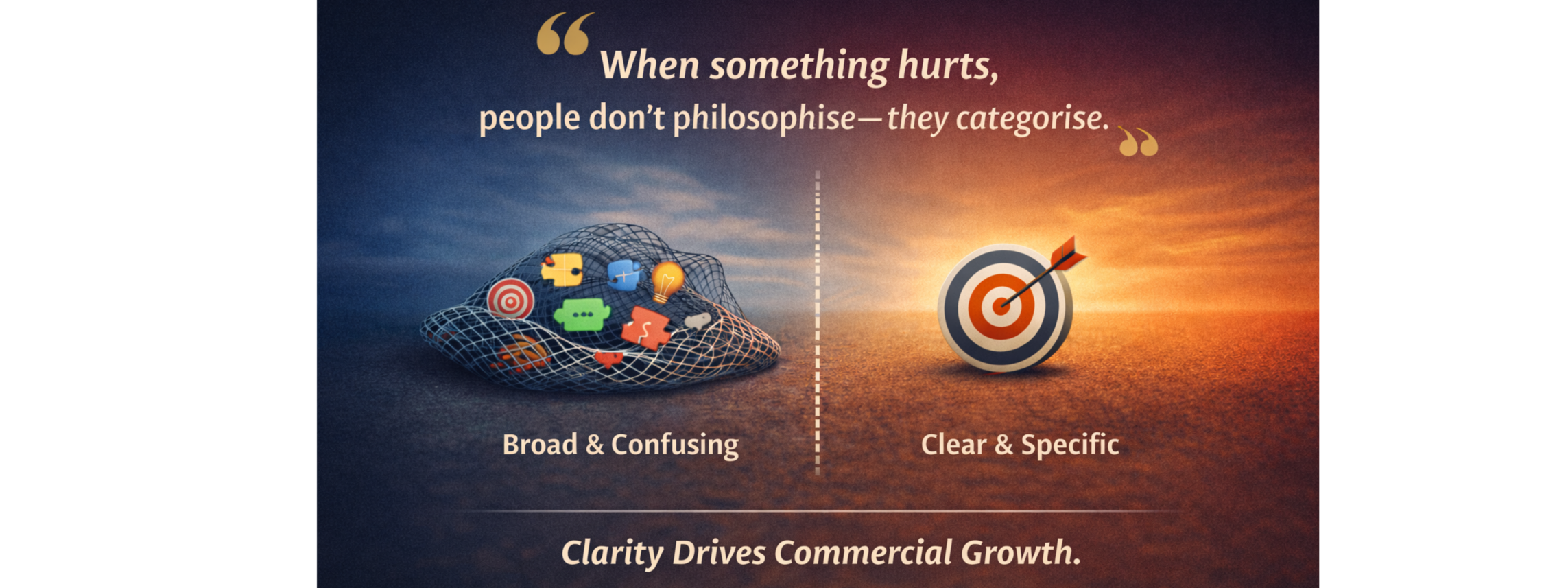
“When something hurts, people don’t philosophise — they categorise.”
That sentence reframed the conversation instantly.
Because in commercial environments, people (our potential clients, and those with budget for our products and services) don’t have the time, or the headspace, to hold complexity. Under pressure, they scan for patterns. They look for signals. They decide quickly which providers fit the problem in front of them.
Which means visibility isn’t about being seen.
It’s about being correctly categorised and recognised at the moment a problem arises and a decision is made.
That framing set the tone for the rest of the masterclass. What followed wasn’t a discussion about content or confidence, but about specificity, positioning and how work translates in commercial reality.
Specificity beats sophistication
In commercial contexts, people don’t sit with nuance. They look for fast pattern recognition. They need to quickly answer: Is this for me? Is this relevant now? Do you solve the problem I’m dealing with?
That’s why Libby Crossland, co-founder of The Leadership Visibility Co., didn’t invite abstract reflection. She asked people to get uncomfortably specific.
She asked the group to complete the following clear framing statements, so the market could categorise them correctly:
-
People pay or hire me when they can’t…
-
Who does this usually happen to?
-
After working with me, they…
That’s where the friction showed up.
“But my work covers a lot…”
The most common challenge voiced in the room was familiar:
How do you stay specific when your work genuinely spans many things?
Especially in OD, where impact is rarely linear and almost never confined to a single intervention.
The response wasn’t to oversimplify the work, but to anchor it.
The idea of a north star landed strongly.
You don’t need to explain everything you do. You need one clear organising principle that people can remember, with a ripple effect that travels outward.
That north star might change over time. It might shift by audience. But at any given moment, there is only one primary answer you want the market to hold.
You can have different responses, but not all at once.
ICP clarity isn’t narrowing, it’s enabling
As the discussion moved on, it became clear that specificity isn’t about boxing yourself in. It’s about helping the right people recognise themselves.
When ICP (Ideal Client Profile) came into the conversation, the tone changed again.
Not as a marketing exercise, but as a commercial filter.
If you’re clear who your work is for right now, it becomes much easier to:
-
choose which outcomes to surface
-
decide which stories to tell
-
let other work sit quietly in the background
Specificity doesn’t reduce the value of the work.
It increases its translatability.
“But how do you show impact when your job is to stop things going wrong?”
One of the most nuanced debates in the session centred on this tension.
Much OD work is preventative.
It stops escalation. It reduces attrition. It prevents harm and crisis.
Which makes it harder to point to a before-and-after metric.
You can’t easily show the crisis that never happened.
The shift here wasn’t towards inventing impact, but towards reframing evidence.
Instead of trying to prove everything, the focus moved to:
-
patterns you’re repeatedly called into
-
risks that no longer materialise
-
decisions that get made faster or with less fallout
The absence of damage is data, but only if you help people see it.
From expertise to decision: visibility as translation
As the conversation unfolded, it became clear that visibility isn’t about amplification or volume.
It’s about translation.
OD work is often preventative, systemic and long-term. It reduces harm, stops escalation and stabilises performance before things break.
But buyers don’t experience that as nuance.
They experience it as a problem they need solved now.
This is where Suzie Thompson, co-founder of The Leadership Visibility Co., and Board member of ODN Europe introduced a practical commercial lens using the SPIN technique.
-
Situation – What’s happening in the organisation right now?
-
Problem – Where is it hurting, slowing or creating risk?
-
Implication – What happens if nothing changes?
-
Need-payoff – What improves when this is addressed well?
Applied to visibility, the shift was subtle but powerful.
Instead of describing the breadth of the work, participants were encouraged to surface:
-
the specific situations they’re repeatedly brought into
-
the problems decision-makers are already feeling
-
the implications that make delay expensive
-
the outcomes that matter commercially
This matters deeply for OD, and many other fields.
Much of the value sits in what doesn’t happen - attrition avoided, conflict diffused, reputational damage prevented.
The work isn’t always loud. But it is consequential.
Visibility, then, becomes the act of helping others recognise that consequence.
Not by simplifying the work.
But by making it legible to people who are categorising under pressure.
When specificity, proof and timing align, visibility stops feeling uncomfortable.
It becomes a commercial advantage for the practitioner, the organisation, and the decisions that follow.
With thanks to ODNE for the partnership, and to everyone who contributed to a session that stayed grounded in the realities of decision-making, risk and commercial impact. These reflections capture the themes and debates as they unfolded in the room.