What does OD need to hold onto in a world in motion?
What does OD need to hold onto in a world in motion?
Reflections on the Summer 2026 edition of OD Review, Vol. 58 No. 2
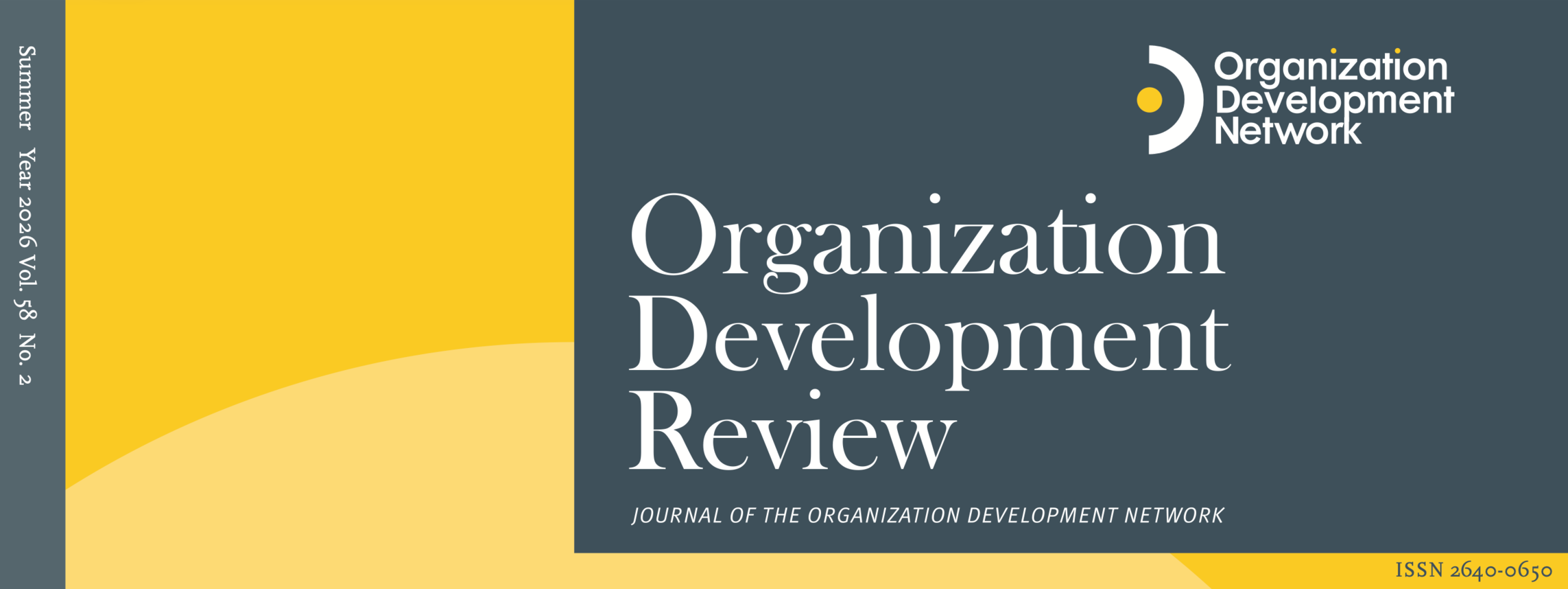
The latest edition of OD Review, New OD Thinking for a World in Motion, brings together a set of contributions that, while quite different in subject matter, sit around a familiar challenge for OD practitioners: how the field continues to evolve without losing the qualities that make its contribution distinctive.
The editors frame the issue around the changing ways organisations are operating, from the continuing need to access collective human intelligence to the increasingly unavoidable question of how artificial intelligence becomes part of OD practice. Alongside this sits a special section marking 30 years of the World Café, as well as contributions on transformation, value, process consultation and organisational networks.
Taken together, the edition does not point towards one answer about where OD is heading. What it does offer is a useful set of tensions for practitioners to sit with.
AI, interpretation and the work before the work
The two contributions on AI are particularly interesting because they move the conversation beyond whether practitioners should or should not use it.
Kyle Swanson presents AI as a partner in practice: useful for processing information, extending research and challenging assumptions, while still requiring context, judgement and discernment from the practitioner. Yuval Dror takes this further by exploring what happens when AI has already been used to interpret an organisational issue before the consultant becomes involved.
That is a more significant shift than it may first appear. Process consultation has always depended, in part, on how the problem is understood and who gets to define it. If leaders increasingly arrive with an AI-generated synthesis, diagnosis or framing already in place, then the practitioner is not necessarily entering an untouched inquiry. They may be entering one in which some meaning has already been created, language has already been selected and certain possibilities have already been made more visible than others.
Dror describes this as part of the changing "interpretive ecology" around the work. The implication for practice is not that AI-generated analysis should be dismissed, but that practitioners may need to become more attentive to the assumptions already embedded within it.
For experienced OD practitioners, this raises a valuable question: when we enter a system, how much of our work is now about understanding not only the presenting issue, but also the way that issue has already been mediated, summarised and organised before the conversation has begun?
Thirty years of World Café and the continuing place of dialogue
The special section on the World Café offers an interesting counterpoint.
Thirty years after its emergence, the method is revisited not only as a facilitation process, but as an approach to collective inquiry and social innovation. Juanita Brown and David Isaacs describe its purpose as creating the conditions for collaborative thinking through linked conversations, where knowledge develops across the system rather than being generated only by those holding formal authority.
Other contributions in the section reflect on the World Café as a form of conversational leadership and as a way of working with difference, participation and common ground.
Its inclusion alongside the AI contributions is useful. One represents a technology capable of processing and synthesising at remarkable speed; the other depends on people being given time and structure to think together.
For OD practitioners, there is something worth noticing in that contrast. The pressure for speed, clarity and efficient decision-making is unlikely to reduce. Yet many organisational issues remain relational, contested and socially constructed. They cannot always be resolved by better analysis alone.
The question, perhaps, is not whether slower, dialogic approaches remain relevant, but where they become more important precisely because so much else is accelerating.
Transformation also requires attention to endings
Lindsey Godwin’s article introduces a different but equally important reframing of change leadership. She positions the change leader as both midwife and hospice worker: someone who supports what is emerging while also attending to what is ending.
This distinction matters because much organisational change practice remains heavily weighted towards the new. New structures, new strategies, new operating models and new behaviours are usually described with far more precision than the things people are being asked to relinquish.
OD has long paid attention to transition, identity and loss, but Godwin’s framing makes the imbalance particularly visible. Organisational transformation is not simply an act of creation. It also involves closure, relinquishment and, at times, grief.
For practitioners, that suggests a more complete reading of change. What is emerging may need facilitation and support, but so too may what is disappearing. If one is attended to and the other is not, the organisation may move structurally while remaining psychologically attached to what has gone before.
What kind of value does OD create?
Lisa Meyer’s contribution brings the conversation back to the field itself.
Rather than asking only which values underpin OD, she examines the different forms of value that OD contributions can create. Drawing on axiology, she distinguishes between conceptual value, instrumental value and legitimacy, arguing in particular for the generative role of conceptual scholarship.
This feels especially relevant in a field that is frequently asked to prove its relevance through practical outcomes.
Instrumental value matters. Practitioners should be able to demonstrate what changed and why their contribution made a difference. But Meyer’s argument creates space for another form of contribution: work that changes how we understand an issue, introduces a new conceptual distinction or provides a more useful way of seeing a familiar problem.
That is not separate from practice. In many cases, it is what makes different practice possible.
It also raises a useful challenge for the field. If OD only values what is immediately measurable or directly applicable, it risks undervaluing the ideas that shape future practice, language and legitimacy.
Seeing the organisation that is actually there
Elizabeth Scott’s case study on social network analysis brings another longstanding OD concern into focus: the difference between formal structure and lived organisation.
The article explores the use of network analysis alongside behavioural assessment to reveal informal influence structures and relationships. The editors describe it as a kind of "relationship MRI", making visible dynamics that may otherwise remain hidden within the formal organisation chart.
This is not a new concern for OD, but the increasing availability of network data gives practitioners different ways to examine it.
Formal structures tell us where authority is intended to sit. They tell us less about where trust sits, where information really travels, who acts as a bridge between groups or which relationships have become disproportionately important to how work gets done.
For practitioners working with leadership, culture or organisational design, this remains central. The system on paper and the system people experience are rarely identical.
A field still concerned with how we see
Across the edition, the strongest common theme may be less about change itself and more about interpretation.
How do we make sense of a system? Who gets to frame the issue? What becomes visible and what remains hidden? Which conversations need to take place before action becomes useful? What do we need to support into existence, and what do we need to help come to an end?
Those are familiar OD questions. The context around them is changing.
AI is becoming part of how organisational problems are interpreted. Network analysis gives us new ways to see relationships. Established dialogic practices continue to offer ways of accessing collective intelligence. At the same time, the field is still asking fundamental questions about what constitutes value and how transformation is understood.
That may be one of the more useful messages from this edition. OD does not necessarily need to choose between established practice and emerging approaches. But it does need to keep examining the assumptions each brings with it.
In keeping with the questions raised in this edition, AI has also played a part in developing this article - helping to synthesise and work through the material, while the interpretation, emphasis and final editorial judgement remained human. In that sense, the process itself reflects Swanson's challenge: not to reject the machine's contribution, but to remain alert to what it has organised and what it may have left out.
The latest OD Review, New OD Thinking for a World in Motion, is available now to ODNE Supporters and Partners.
For those working in the field, perhaps the more interesting question is not simply which article resonates most, but which of these tensions is already showing up in your own practice.