Meet the Member - Dr. Florin Ioan (Peti) Petean
Warmth, Honesty and the Long Game of Change
Interviewed by Suzie Thompson
When you first meet Peti, two qualities show up before he says a word: warmth and candour. He laughs about being “too blunt” sometimes, but it’s said with the disarming curiosity of someone who simply cares about people and wants to understand what’s really going on. That combination has shaped a three-decade career helping leaders and teams face complexity and transform how they work—without losing their humanity.
From computer code to human systems
Peti began as a computer engineer—brilliant with maths, yet he soon realised he missed the human side of the work. “I found I thrive when the work keeps me close to people,” he admits. The turning point came in 1994, when he was selected to help form the Centre for the Development in Management (CDM) in Transylvania and sent for eight weeks’ training at Roffey Park in the UK. The experience was a cultural shock—in the best way—opening a world of psychology, group dynamics and practical tools for being curious without intruding. Mentors like Mike Plumridge and board guidance from Val Hammond shaped his early practice.
Back in Romania, he began translating what he’d learned into a rapidly changing context. As multinationals expanded into the region, he worked with automotive and technology players—from Renault and Ford to Bosch, Nokia and major tier-one suppliers—“another culture with clearer expectations,” as he puts it. The work stretched him into comparative management and cross-cultural models (Hofstede and others), helping him explain difference with respect and precision.
There are small details that say a lot about that era. At Roffey Park, the free fruit table became a running joke—Romanian trainees devouring bananas they couldn’t easily afford at home. It’s a memory he tells with affection, a glimpse of how learning, dignity and humour often arrive together.
A favourite intervention (with mountain sessions and hired bands)
Ask Peti for a professional highlight and he doesn’t pick a glossy corporate programme. He tells the story of a brilliant, unruly satire team—Romania’s answer to Monty Python—who needed to evolve from “a gang of crazy people” into an organisation without crushing their creativity. The work ran for months, including sessions in the mountains; the group even hired bands for mini-parties each evening. The conflict was real, the personalities larger than life.
Peti’s approach? Enter carefully, listen for the person behind the role, notice strengths, and only then move to problems and structures. He didn’t call it OD at the time, but on reflection it was textbook practice: contracting and entry, inquiry, building on what was already brilliant, then co-creating light-touch structures the team could actually live with. “I can’t pretend it was because I was clever,” he says. “I was trying to help them, and it came naturally.”
What people say when he leaves the room
Peti is proud of his Transylvanian roots, often associated (in his words) with warmth, seriousness and being close to people. He recognises the stereotype with a smile—and doesn’t overclaim it—but the theme comes up repeatedly when others describe him.
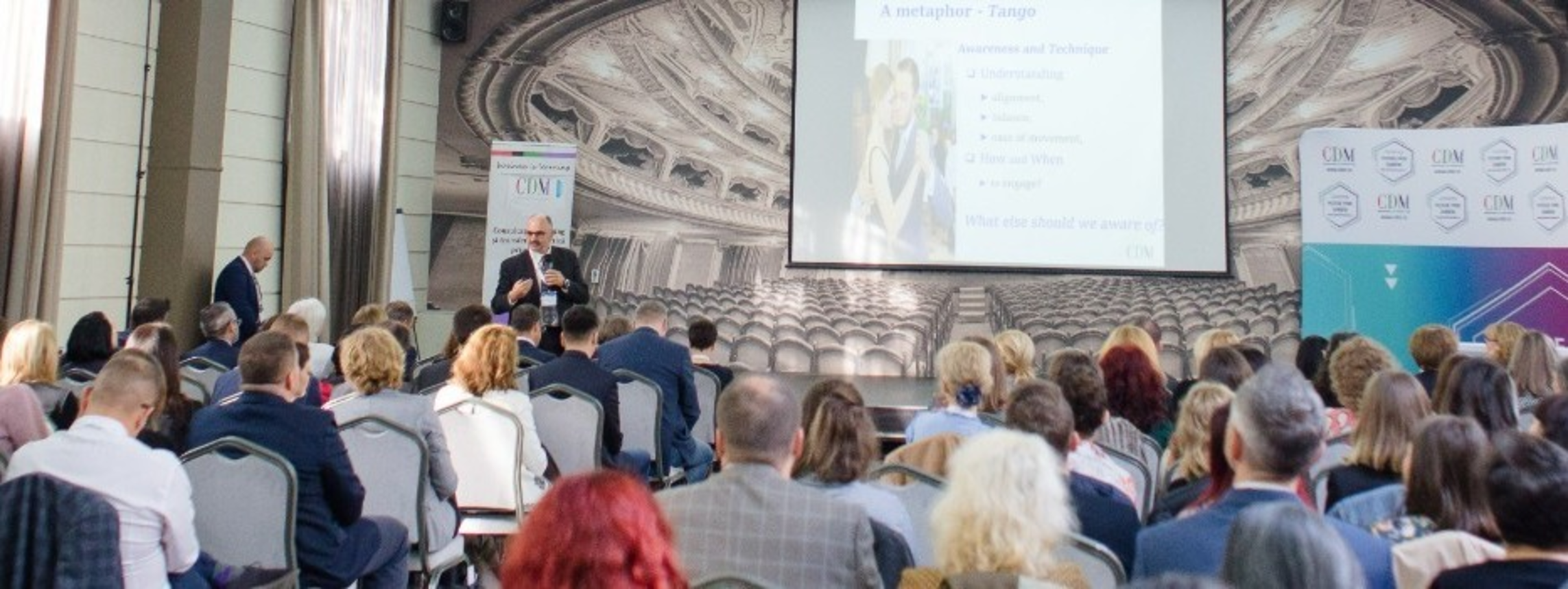
That closeness shows up in how he convenes. He lights up when people meet at an event, ask for an introduction, and leave with a new collaborator. He calls it being the “capitaliser”—turning energy into action—and it clearly gives him joy.
Why he volunteers his time to lead
Alongside client work, Peti serves as Co-chair of the board. His driver is straightforward: he believes Europe needs more human-centred, long-term OD—practice that helps leaders and consultants be genuinely transformative and build communities where people can be happy at work. It’s a conviction born from decades in systems where the stakes are real and time at work is most of life.
He’s seen the ripple effects, too. In addition to major corporates, he has supported senior public leaders, including advising a friend who later served as Romania’s Deputy Prime Minister, illustrating how thoughtful development work can travel beyond organisations into national life.
What drives him (beyond work)
Peti reads widely, follows his curiosity down intellectual rabbit holes, and loves film—his all-time favourite is the Italian classic La vita è bella. At home, he and his partner strike a thoughtful balance, he’s the extrovert of the pair, they recharge quietly—so they keep social time small and spacious. It’s an endearing portrait of a connector who also honours boundaries and care.
The lesson he’d give his younger self
Asked for one piece of advice to his younger self, he doesn’t hesitate: be closer to my boys. He’s grateful for strong relationships with them now, but he won’t romanticise the trade-offs. The honesty is typical Peti, and a reminder that even people-centred professionals can sometimes miss what matters most at home.
Navigating uncertainty: two anchors
After a career of change on every front, Peti boils his guidance down to two learnable skills:
-
Humility — go in to learn, not to win.
-
Acceptance — look for workable agreement and understanding, not uniformity of views.
People aren’t “bad,” he says; they’re often afraid. When we understand that, we can actually help. In a chaotic world, these two anchors still hold.
Why Peti’s story matters
Read through the lines and you’ll see a through-line: translate complexity into human connection. From early days digesting cross-cultural theory because textbooks were unaffordable, to late nights helping a gifted creative team organise without losing spark, to patient community-building across borders—Peti keeps choosing people, then structure. He learns the system before changing it. He looks for what’s already working. And he treats warmth and seriousness not as opposites, but as partners.
That’s the long game of change, and it’s a very European one: pragmatic, generous, and deeply human.
Interviewing Peti reminded me why this work matters. In rooms that tilt toward noise or ego, he brings a steady, human centre—curious first, courageous always. He notices what’s alive, asks the question no one else will, and somehow leaves people feeling seen rather than exposed. I’m grateful to have him in my orbit because he turns intent into momentum; ideas don’t just sparkle around Peti, they take shape. He models the kind of leadership I want near our community—serious about impact, generous with credit, unafraid of truth. When he’s involved, I trust the work will be wiser, kinder and built to last.
To be featured in a future Meet the Member article, email [email protected]