
Functional Stupidity: OD’s role in its downfall
James Traeger, Mayvin
This year, perhaps more than any, will prove to be one where truth is contested. This will be in our political arena of course, but also in that of communities and organisations too. Something called ‘functional stupidity’ abounds. How might the relational practice of OD be the saving grace of these times?
No longer can it be claimed that data are objective. Even in the science of Psychology, OD’s big brother if you like, there is a crisis of sense-making. The science editorial of the Economist quoted Psychology Professor Ulrich Schimmack from the University of Toronto:
‘The bigger issue in my opinion is all the spin… including statistical practices…that biases results in favour of researchers’ beliefs’ (The Economist 13/1/24 p 76)
What role could OD play in this cacophony of competing truths? I suggest the relational side of our practice may be more important than ever.
What role could OD play in this cacophony of competing truths? I suggest the relational side of our practice may be more important than ever. That is because what we do, in short, is bring diverse people together to build collective sense-making. As an example, here is a story, drawing on my own experience as a team coach:
The team were finally getting somewhere. On my right, the quiet fellow roused himself to speak.
‘Sometimes I wonder; does what we discuss here make much of a difference at all to our customers on the ground?’
It was a provocative, powerful intervention, in a forum of senior leaders in a healthcare-related organisation. There was a pause. His colleagues sat very still. I even think I heard a small gasp from one of them. The atmosphere in the room solidified slightly. Was it my imagination or did the light shift at all? Then the CEO asked, in a slightly high-pitched voice:
‘That’s an interesting question, John. What do others think about that?’
Laughter broke the mood. The conversation became more engaged, even heated at times, but always with a respectful edge, as others also began speaking up to express their frustrations and their desire for more impactful change. Some decisions to do a few small but significant things differently were made; good ones in my view, and which were the only ones that could be made at that meeting, at that time. They had been building up to this, in previous conversations. What John had said may not have may not sound like much of a revelation at one level, but for them as a team, it was a profound moment, like a curtain being drawn back. And it had come from the ongoing work of deepening cycles of trust, vulnerable honesty and truth-telling.
This is an example of what my colleague Professor Rob Warwick (of the University of Chichester) and I are calling ‘relational critical thinking’. When I say the words, ‘critical thinking’, what images does your mind conjure? Perhaps for many the image that emerges is one of solo contemplation, like Rodin’s famous ‘The Thinker’. The vital quality that may be missing from this image is the relational aspect of the story above. We maintain that good thinking, and the quality decisions that ensue, are fundamentally social and contextual processes. This is a timely quality, a vital one in an era of disinformation and fake news, and one that OD is well placed to facilitate.
The story is significant for the better quality of decision-making that came after this moment. It was more collective, more thought-through, went deeper into the heart of things; in short, their thinking together had a more critical edge. In the careful cycles of increasingly significant conversations that we had, this group broke through a barrier, making more significant collective contact with what they really felt as well as what they thought. Better action comes from both.
This barrier might be seen as one of what Alvesson et al call ‘functional stupidity’, which they define as:
‘an absence of reflexivity, a refusal to use intellectual capacities in other than myopic ways, and avoidance of justifications.’ (Alvesson & Spicer 2012).
Never has functional stupidity been more of a danger than in our times. So how can we break through the functional stupidity barrier and enable people and teams to be ‘cleverer’, to exhibit useful relational criticality. The pragmatic philosopher John Dewey defined critical thinking as:
An ‘active, persistent, and careful consideration of a belief or supposed form of knowledge in the light if the grounds which support it and the further conclusions to which it tends (Dewey, 1910, p6)’.
What is missing from Dewey’s definition, though is our view that criticality is fundamentally a collective and relational practice, rather than an individualised, towel-wrapped-round-the-head, puzzle-unpicking exercise of grey matter alone. And with the appreciative lens that OD often looks through, we distance criticality from ‘being critical’. It is possible to offer a loving critique of something. I often picture this as looking at it as if it is a jewel, holding it up to the light, studying its facets and seeing how the light shines through it.
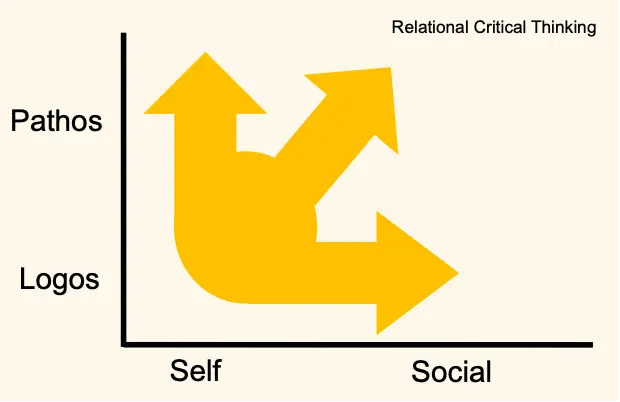
As this diagram shows, where self-oriented ‘logos’ is the narrow, instrumental type of thinking normally associated with a traditional organisational practice, and which leads to the type of myopic functional stupidity that Alvesson et al discuss, then ‘socially engaged pathos’ is the wider, experienced, relational and emotional territory of OD. Whereas traditional problem solving in organisations is done within a narrow set of logics, (the bottom left corner of the above diagram), the work of OD is to bring in diverse experiences and feelings, which makes for a more wholistic perspective and therefore better decision-making. This also makes the more fundamental case for diversity in our practice. Of course, taking account of diversity matters for ethical reasons; it is just the right thing to do. Additionally, it is also an argument against functional stupidity and for the relational critical thinking that the complex world of organisations inhabit. Functional stupidity is often associates with the ‘pale, stale, male’ atmosphere that still dominates most executive suites.
But we offer a health-warning here: if what we are after is functional cleverness, an engaged relational process that can lead to wise decisions and outcomes, then there is no short cut. This approach cannot be ‘techniqued’. It takes some time and genuine interpersonal investment. It is hard to fake it, even if faking it wasn’t at question anyway from an ethical perspective. Relational critical thinking requires a genuine concern for the wellbeing of people in the course of organisational work. In fact, we may even infer that in an increasingly challenging context, the wellbeing of people becomes a primary task in organisational life. This asks all manner of questions, to be sure, about what work is for and who benefits. These questions are important but not necessarily the consideration of us right now.
What we want to emphasise is that for there to be high quality critical thinking as a relational task, it may take some time, space and emotional investment. But we don’t have time to rush this. We need to go slow to go fast in these strange times.
References:
Alvesson, M. and Spicer, A. (2012). A Stupidity-Based Theory of Organizations. Journal Of Management Studies, 49(7), pp. 1194-1220. doi: 10.1111/j.1467- 6486.2012.01072.x
Dewey, J. (1910) How we think. DC Heath and Co. Available at: https://openlibrary.org/books/OL7236952M/How_we_think.
The Economist 13/1/24
Fancy Joining in the Conversation?
PS In the Spring of 2024, Rob Warwick and I are running a low-key action research project entitled ‘How do we solve complex problems through relationships?’. In the spirit of action research, our approach will be conversational and hopefully useful to those who take part. Let us know if you’d like to take part. Contact: [email protected] for more details.