A Theoretical Container for OD – Structuring Diversity

Published on December 30, 2024

The Many Faces of the Middle Manager: A Journey Through Paradoxes

Jesse Segers, Ginkgo Consulting

In our previous blog, we explored the various schools of Organisational Development (OD), each offering a unique lens on what organisations and systems are and how they change. While this diversity is a key strength of OD, it also raises the question of whether a unifying framework could help bring these perspectives together. In this blog, we examine the concept of a "theoretical container"—a structure that bridges diverse OD approaches. Using this framework, OD professionals could learn and work across professional and national boundaries, maximising the field's potential for organisations and society.

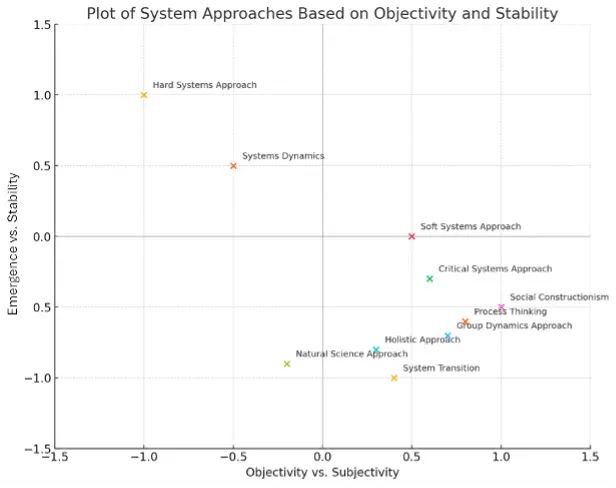
This proposed container is built around two or three axes.


The Three Axes of OD


1. Axis 1: Objectivity vs. Subjectivity

This axis describes the degree to which systems are viewed as objective, external phenomena versus subjective, human-experiential constructs.

  • Objective: Systems are seen as technical and predictable, designed and managed by an outsider.
  • Subjective: Systems are shaped by human relationships and meanings, with the practitioner actively participating in the co-creation of meaning.


2. Axis 2: Stability vs. Emergence

This axis indicates whether the system is perceived as stable and predictable or as continually evolving and self-organising.

  • Stability: Focus on maintaining or restoring existing structures and patterns, with an emphasis on control and predictability.
  • Emergence: Systems develop dynamically, with flexible boundaries that allow for new patterns and self-organisation.


Diagnostic vs. Dialogic OD on These Axes

Traditional OD approaches, particularly in the United States, have historically been diagnostic, rooted in positivist-empirical science. Problems are defined as measurable phenomena, diagnosed, and resolved (Bushe & Marshak, 2009). These approaches fit squarely into the upper-right quadrant of the axes: objective and stable.

In recent decades, OD has shifted toward dialogic practices, emphasising meaning-making through dialogue and collective reflection. Instead of diagnosing objectively existing problems, dialogic OD focuses on how individuals co-create their realities and how change emerges through interaction, narratives, and shared constructions (Bushe & Marshak, 2014).

Currently, hybrid models are becoming more common, blending diagnostic and dialogic elements to meet the specific needs of organisations. These approaches combine the structure of traditional models with the adaptability of participatory methods.

 

3. Axis 3: Individual Change vs. System Change

This third axis differentiates between a focus on personal development within a system versus changes in the overall system and its interdependencies.

  • Individual: Interventions emphasise personal growth and behaviours within the system.
  • System: Focus on systemic change, often by adjusting structures and processes to influence relationships and interdependencies.


Mapping OD Schools Within the Framework

A simplified table maps each school’s relative position on these axes:


School

Objectivity

Stability

Individual/System

Hard Systems Approach

Objective

Stable

Systemic

Systems Dynamics

Objective

Stable

Systemic

Soft Systems Approach

Subjective

Emergent

Systemic

Social Constructionism

Subjective

Emergent

Individual

Group Dynamics

Subjective

Emergent

Individual

Holistic Approach

Subjective

Emergent

Systemic

Critical Systems Approach

Subjective

Emergent

Systemic

Natural Sciences Approach

Objective

Emergent

Systemic

Systems Transition

Subjective

Emergent

Systemic

Process Thinking

Subjective

Emergent

Systemic


Differentiating Schools Within the Subjective-Emergent Quadrant

Many schools cluster in the subjective-emergent quadrant, focusing on subjective experiences and the dynamic, evolving nature of systems. To distinguish these schools, we can explore their primary focus or mechanism of change:


1. Individual Experience vs. Collective Dynamics

  • Individual Experience: Schools like Group Dynamics and Humanistic Approaches prioritise individual awareness, growth, and interpersonal dynamics. These approaches often use experiential learning to foster personal transformation as a gateway to systemic change.
  • Collective Dynamics: Schools like Tavistock’s psychodynamic approach and Social Constructionism focus on group and interpersonal processes, examining shared beliefs, roles, and group dynamics as collective phenomena.

2. Meaning-Making vs. Structural Power Dynamics

  • Meaning-Making: Soft Systems Theory and Social Constructionism emphasise co-creating shared insights and organisational realities through dialogue and subjective meaning-making.
  • Structural Power Dynamics: Critical Systems Theory and Tavistock approaches focus on power, inclusion/exclusion, and social justice within systems, exposing hidden power structures to promote both adaptability and equity. 

3. Adaptive Learning vs. Self-Organising Complexity

  • Adaptive Learning: Human Systems Dynamics (HSD) and Learning Organisations foster environments that continuously evolve by recognising patterns and enhancing responsiveness.
  • Self-Organising Complexity: Process Thinking and Holistic Approaches view systems as inherently self-organising, evolving through internal dynamics rather than structured feedback.


The Value of a Theoretical Container

By creating a container that accommodates all schools, each perspective finds its place, fostering collaboration and integration across approaches. However, it remains to be seen whether this theoretical framework will influence practice or whether OD professionals—valuing their flexibility—will resist rigid structures.

This will be explored further in our next and final blog, where we examine the unique, paradoxical identity of the OD professional and the interplay between flexibility and structure within the field.


References

  • Bushe, G. R., & Marshak, R. J. (2009). Revisioning organization development: Diagnostic and dialogic premises and patterns of practice. The Journal of Applied Behavioral Science, 45(3), 348-368.
  • Bushe, G. R., & Marshak, R. J. (2014). Dialogic organization development: The theory and practice of transformational change. Berrett-Koehler Publishers.